Where to start with AI · First workflow No. 4
An NDA review assistant, rolled out in two stages: first it flags deviations for the lawyer, then, on its own, it clears NDAs that differ from the template only in the designated fields.
A first AI use case doesn’t need to be spectacular. It does need to be narrow enough to test, measure, and improve.
Nondisclosure agreements (NDAs) meet all four tests of a good first workflow: they come up often, they have a clear owner, they call for a clear output (a clause-by-clause issues list), and they are a pain point that legal, sales, and procurement already feel.
The use case is low-risk only within a strict scope:
The assistant compares each NDA against a template and a standard position the legal team already has. The risk does not go away. It becomes more visible, measurable, and manageable once the position, the scope, and the escalation thresholds are defined.
Document the template, acceptable fallbacks, and red lines clause by clause; give each rule an owner and a dated version. The tool comes after.
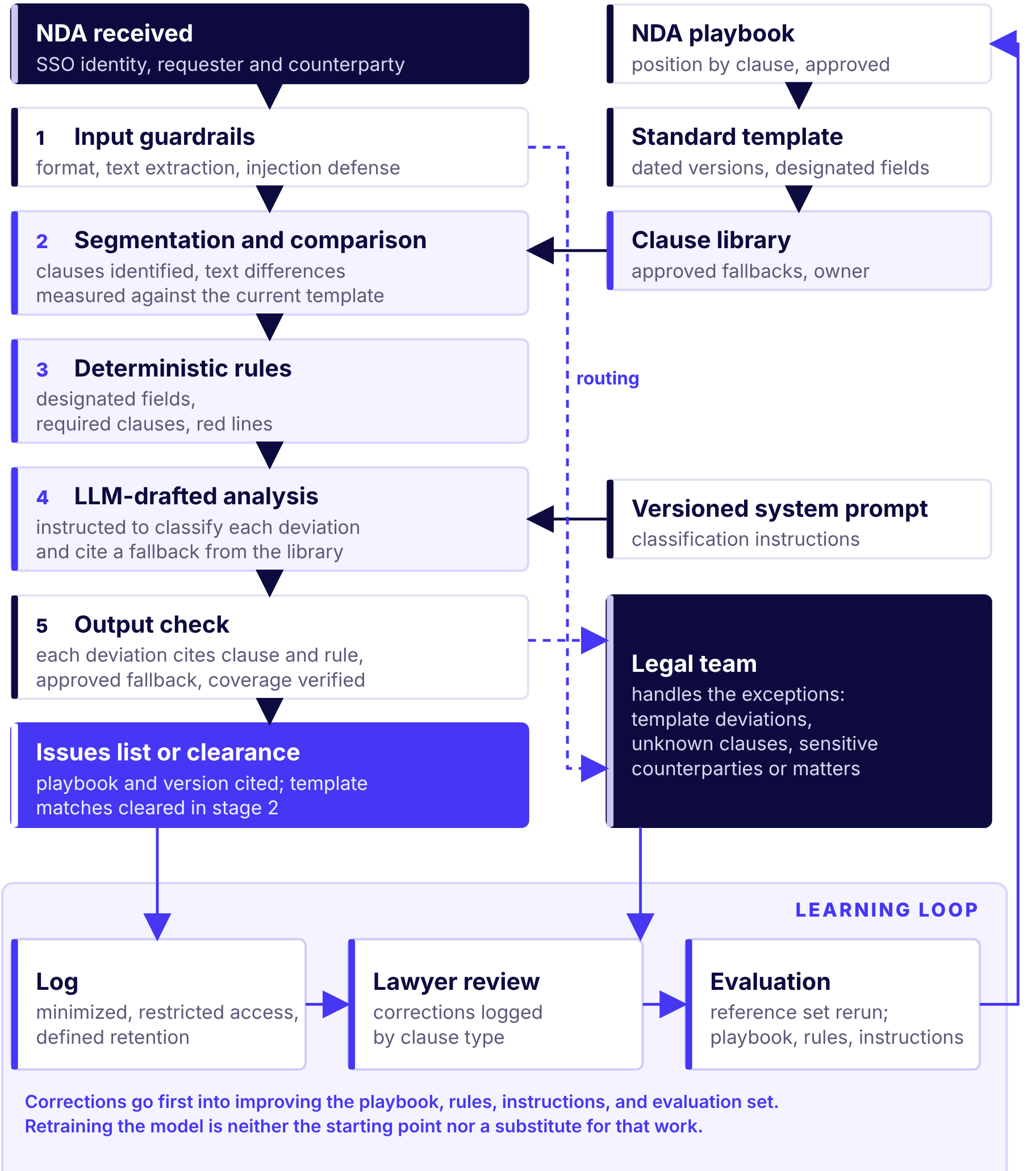
The assistant compares the incoming NDA with the standard template and the playbook, flags deviations clause by clause, cites the relevant rule, and suggests fallback language from the approved clause library. The lawyer accepts, negotiates, or redrafts. Every correction is logged by clause type.
It clears for signature, without lawyer review, any NDA that uses the current standard template and differs only in the designated fields, for an approved agreement type and counterparty. It routes to legal any departure from the template, however slight, any NDA on the counterparty’s paper, and any sensitive agreement. A person always signs.
The move to stage 2 should not be decided in advance. It depends on what legal observes during stage 1: the accuracy of the deviations flagged, the deviations missed, and the system’s ability to recognize NDAs that fall outside its scope.
Prospect NDAs on the standard template could move to stage 2, while partnership NDAs stay in stage 1.
Clause-by-clause segmentation of the NDA, text comparison against the standard template, deterministic rules for designated fields and red lines, an analysis drafted by an LLM instructed to cite the playbook and an approved fallback, and input and output guardrails with routing to legal. A loop connects the log, lawyer review, and the evaluation set.
The controls required before any autonomous answer:
Corrections go first into improving the playbook, rules, instructions, and evaluation set. Retraining the model is neither the starting point nor a substitute for that work.
The goal is not to take contract review away from legal. It is to shorten turnaround on standard NDAs, stop rereading the same clauses by hand, and free up lawyers’ time for agreements that call for context and judgment.
Illustrative case: fictitious company; all figures are approximate. Sergio Castagna Consulting is a member of the OpenAI Partner Network and a registered partner in the Google Cloud Partner Network. The tool comes after the problem is defined.
The question is not “Which tool should we buy?” It is “Which repetitive work can we have AI assist with, measure, and then delegate under clear controls?”